
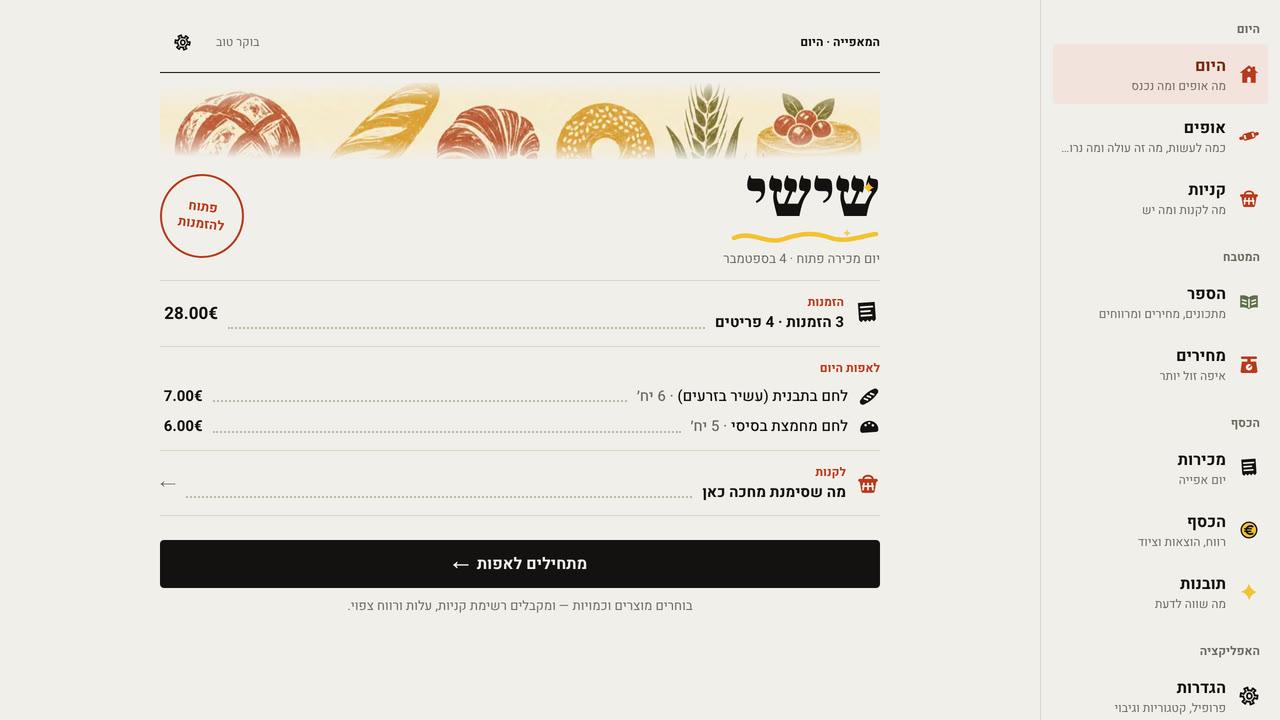
Help a home bakery plan production, shopping, costs and profit from a phone.
Made A Hebrew, right-to-left app built around the baker’s own price list.
Read the full story
המאפייה — Bakery OS — is a small piece of software built for one home bakery in Athens: sourdough breads and yeast cakes, sold at a Friday market. It is Hebrew, right-to-left, and phone-first, because that is the device it gets used on, standing in a kitchen.
The whole app answers four questions in order: what are we baking → what do we need to buy → what will it cost → what do we earn. Nothing else is on the screen. The bake planner is step one; the recipe view is where cost, price, profit and margin sit side by side per product.
The numbers are not invented. Every ingredient, component and product is transcribed from the baker's own pricing spreadsheet — 32 ingredients, 10 reusable components, 9 products, plus the equipment tab — and a parity test asserts that all nine products reproduce her price list to the cent. That test is the contract: if it fails, the app is lying to her and nothing else matters. Two figures in the source turned out to be wrong, and both were corrected only because her other rows proved it.
The modelling is where the leverage is. Recipe lines come in three kinds — weight, unit (fractional: three quarters of an egg is real data) and a flat labelled adder — and products compose from shared components, so nine products come out of ten parts and a flour price change is one edit rather than nine. Rounding happens per recipe line, half-up, because her sheet does the same and it is the difference between a filling reading €2.22 and €2.21.
Built on Next.js with Neon Postgres and Drizzle. The domain layer — the cost engine, the money arithmetic, the catalogue — imports no database at all, which is what makes the part that has to be right provable on its own.
In September 2026 the surface was redrawn as הגיליון — the Edition: a printed bakery ledger rather than a dashboard. One sheet of warm paper, no cards and no shadows, hairline rules and dotted leaders, Frank Ruhl Libre over Heebo, and a set of hand-carved stamps drawn for the app in place of emoji. Three inks carry the meaning — terracotta for the action, olive for profit, butter for a highlight.
It is not a demo. One repository deploys a copy per bakery — the same commit everywhere, a separate database and passcode each — so a schema change has to land on every copy or the deploy fails loudly. An in-app assistant sits on top of the same cost engine.